


What is franchise lead generation?
Franchise lead generation is how franchise brands, franchise sales organizations and franchise consultants attract prospective franchisees, then qualify who fits and has the resources to succeed as an owner. Brands and franchise sales organizations recruit for a specific concept. Consultants match each candidate to the right brand. Either way, volume is the easy part. Putting the right owner in the right franchise is the goal.
This guide shows how to reach that goal with real data: where candidates come from, which sources produce qualified ones, and how to qualify them fast.
The numbers come from two places: VipeCloud’s quarterly Franchise Lead Source reports which aggregate lead flow across franchise development teams using VipeCloud’s prebuilt parsing rules and third-party franchise industry data linked to its source. Download the full reports.
Franchise lead generation by the numbers (Q3 2026)
- 69% of franchise leads arrive outside business hours.
- 80% of leads come from just five channels.
- 18% of parsed leads became a booked meeting.
- 5×: a brand’s own capture form books meetings five times as often as portal leads.
- 1 in 3 consultant leads books a meeting. Fewer than 1 in 10 brand leads do.
- 46% vs. 38%: AI-answered leads booked more often than leads worked by a team’s own email sequence.
Start with your ideal franchisee profile
Before you buy a single lead, define who you’re recruiting. The profile decides which channels you fund, what your capture form asks and who advances past the first call.
| Fit area | What to define | Example qualifying question |
|---|---|---|
| Financial capacity | Liquid capital and net worth needed against your total investment range | “How much liquid capital could you invest in a business?” |
| Motivation | Why now, and what they want the business to give them | “What’s driving you to look at business ownership?” |
| Ownership model | Owner-operator or investor with a designated operating partner | “Do you plan to run the business day to day?” |
| Operating ability | Leadership, staffing and management experience | “Have you led a team or run a P&L?” |
| Territory | Markets where you’re actively awarding | “Which city or region are you considering?” |
| Growth path | Single unit, small area development or multi-unit | “Are you considering one location or several?” |
| Timeline | When they’re ready to sign and open | “When would you like to be open?” |
The same fit areas apply to whoever is recruiting. Consultants apply them across a portfolio of brands to find the right match. Franchise sales organizations apply them for each brand they represent.
A useful way to sort candidates is into three tiers: single-unit ready, small area development ready and enterprise ready according to FranchisorSales.org. Each tier gets a different conversation and a different territory plan.
In VipeCloud, each fit area can be a custom contact field. That lets you capture answers on forms, filter candidates and trigger the right follow-up automatically.
Where do franchise candidates come from in 2026?
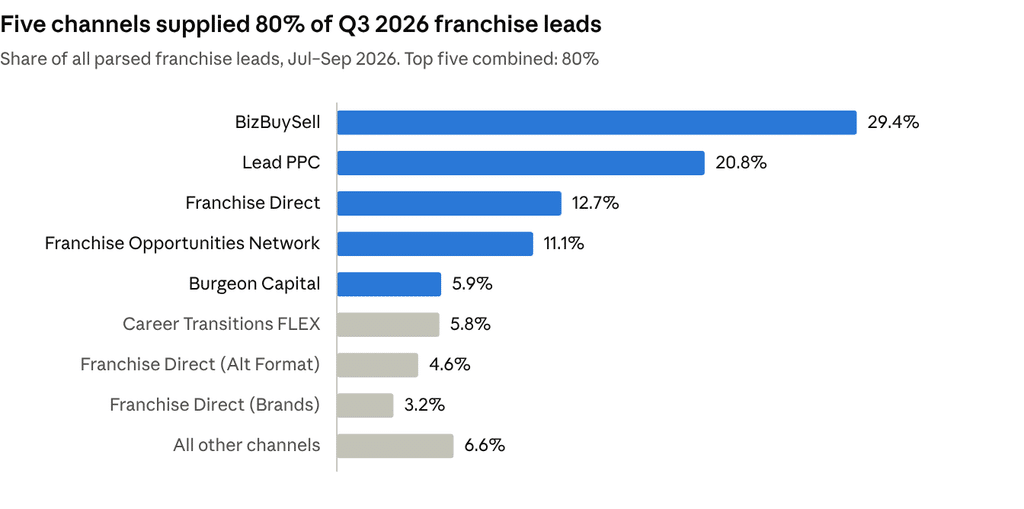
Most franchise candidates now come from a handful of lead sources: five supplied 80% of all leads parsed in VipeCloud in Q3 2026. Three quarters earlier, those same five supplied 45%. In Q3 2025, 61% of leads came from a scattered long tail outside the top five. By Q2 2026 it was 18%, and in Q3 it was about 20%.
Source: VipeCloud Q3 2026 Franchise Lead Source report, Jul–Sep 2026, shares of leads parsed by prebuilt rules
Lead portals and directories
Portals such as BizBuySell, Franchise Direct and Franchise Opportunities Network carry most of the volume. BizBuySell has been the largest channel for four straight quarters, at 31.4% of Q2 volume and 29.4% of Q3. In Q2, BizBuySell and Franchise Opportunities Network took 57.7% of all leads between them. In Q3, BizBuySell and Lead PPC took 50.2%.
Franchise Direct gained share for the third quarter in a row, from 10.7% to 12.7%, and is now the third-largest channel. Franchise Direct (Brands) came online in Q3 and reached 3.2% of volume, making the top eight in its first three months.
Paid digital advertising
Digital advertising and brokers are franchisors’ two most common deal sources: 44% and 43% of franchisors named them in Franchise Update Media’s 2026 Annual Franchise Development Report (AFDR). Within digital, franchisors named franchise portals (37%), pay-per-click search (33%), social media ads (33%) and SEO (29%) as deal sources.
Pay-per-click also stood out on quality. 26% of franchisors rated it their best digital source for lead-to-close, ahead of portals (21%) and SEO (18%). Digital marketing takes about 29% of franchise development ad spend.
Paid leads still need working. Across all sources, average cost per lead rose from $271 in 2024 to $351 in 2025. Cost per new franchisee rose from $13,757 to $17,550. Only 2% of leads became sales, and the average path from first lead to signed agreement took 24 weeks.
Franchise consultants and broker networks
About half of franchisors work with franchise brokers: 52% in the 2026 AFDR, a share that has held steady for five years. Of those, 70% closed at least one broker-sourced sale in the past year. Most broker deals came from service brands with investments of $100,000 to $250,000.
Franchisors, not candidates, pay brokers, and only when a territory is awarded, according to the International Franchise Professionals Group (IFPG) in a public comment to state securities regulators (NASAA). The same comment says brokers account for 80–90% of franchises awarded for many systems, and that one candidate may be introduced to 3–5 franchisors. Some franchisors pay extra for broker reach: 21% pay additional marketing fees to broker systems, and 12% pay for preferential treatment on leads (AFDR).
Capital and financing partners
How a candidate funds the deal shapes whether they qualify. Among franchise owners who financed through Guidant Financial, rollovers as business startups (ROBS) were the most common method in 2026. 28.0% used personal cash, down from 35.2% in 2025, and 21.7% used SBA loans. Guidant surveyed its own clients and provides ROBS, so ROBS is likely overrepresented.
The mix changes every month
Nineteen sources produced volume in Q2 and seventeen in Q3. In Q2, three new channels went live and together took 4.1% of volume. In Q3, six came online or returned and eight paused, and the second-largest channel changed. BizBuySell alone went from 36.3% of July’s leads to 21.3% of September’s, while Lead PPC climbed from 9.1% to 27.7%.
Volume grew 8.6% from April to June, while Q3 volume held steady as channels traded places underneath. VipeCloud’s prebuilt parsing rules read each portal’s lead emails as they arrive, so a new or paused channel shows up the same week rather than at quarter end.
Which lead sources produce qualified franchise candidates?
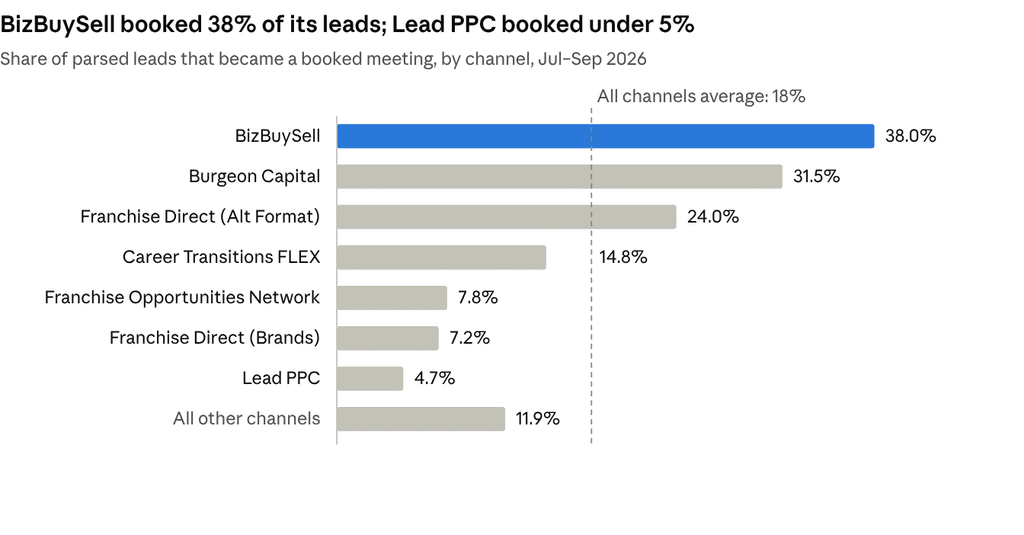
In Q3 2026, 18% of parsed franchise leads became a booked meeting, but rates ranged from 38% to under 5% by channel. A booked meeting is the first sign a lead is a real candidate. That makes it a better ranking than lead count.
Source: VipeCloud Q3 2026 Franchise Lead Source report, Jul–Sep 2026, teams that book meetings in VipeCloud
BizBuySell supplied about a quarter of Q3 leads and more than half of all booked meetings, 2.1× its share of volume. Lead PPC was the second-largest channel by volume and booked 4.7%. Two of the four largest channels booked under 8%.
The pattern held in Q2. Roughly 1 in 4 parsed leads (24.6%) booked a meeting. BizBuySell booked 42.4% of its leads and supplied 65% of booked calls, 1.7× its share of volume. Burgeon Capital booked 33.3%, Franchise Direct (Alt Format) 16.5%, Lead PPC 14.3%, Franchise Opportunities Network 11.5% and LinkedVAnow 10.6%. The best and weakest major channels were more than three-fold apart.
How to compare channels: cost per booked meeting
Cost per lead treats a 38% channel and a 5% channel as equals. Divide each channel’s spend by the meetings it booked instead:
\text{Cost per booked meeting} = \frac{\text{Channel spend}}{\text{Leads} \times \text{Booking rate}}
At the same spend and lead count, a channel booking 38% costs about one-eighth as much per meeting as one booking 4.7%. Take the same math one step further, to cost per awarded franchise, by keeping each lead’s source attached to the opportunity all the way to signing.
Franchise lead conversion benchmarks: consultants vs. brands
Franchise consultants booked a meeting with 1 in 3 parsed leads in Q3 2026. Franchise brands booked fewer than 1 in 10. A single industry average describes neither, so benchmark against teams that recruit the way you do.
| Segment | Booking rate (Q3 2026) | Typical lead mix |
|---|---|---|
| Franchise consultants | 33% | Business-for-sale marketplace inventory such as BizBuySell |
| Franchise brands | 8% | Mostly franchise directory volume |
Why consultants book more meetings than brands
The gap reflects how each one sells, not just lead quality.
- Consultants match across many brands. A candidate who isn’t right for one concept can be shown another. A brand can only offer its own, so a lower hit rate is natural.
- Candidates pay neither. Working with a consultant or a brand costs the candidate nothing. Franchisors pay consultants, and only when a territory is awarded (IFPG).
- They buy different inventory. Consultants lean on business-for-sale marketplaces such as BizBuySell, where buyers are already shopping for a business. Brands buy more volume from franchise directories such as Franchise Opportunities Network, FranchiseGator and Franchise Direct. Directories list franchise concepts only and let candidates contact franchisors without visiting each brand’s site. Franchise Direct, for example, charges franchisors per lead.
On the one directory both segments buy in volume, consultants booked meetings 2.3× as often as brands in Q2 2026. For brands, more directory volume rarely closes the gap. Owning the page the inquiry lands on, and qualifying from the first conversation, do.
Own the page: your website is your best franchise lead source
Leads captured on a brand’s own form booked meetings about 5× as often as leads from portals in Q3 2026. For consultants the multiple was nearly 2×. It’s the one channel a franchise development team controls outright.
The gap is widening. In Q2 2026, own-form leads booked about 3× as often as portal leads for brands. By Q3 it was 5×.
What your franchise opportunity page needs to convert
- A capture form one click from every opportunity page.
- Investment range, territory availability and the next step, stated plainly.
- Three or four qualifying questions on the form, drawn from your ideal franchisee profile:
- Liquid capital available to invest
- Target market or territory
- Timeline to open
- Owner-operator or investor
- An immediate reply after submit. A booking link helps candidates who are ready now; everyone else needs fast, personal follow-up.
- Source tracking on every form, so these leads show up in your channel reports.
VipeCloud forms map each answer to a contact field and can alert the owner on every submission. A candidate’s capital and timeline are then on the record before the first call.
Make sure AI assistants can read it
Franchise buyers can research brands by asking ChatGPT, Perplexity, Claude and Google AI Overviews. If those tools can’t read your site, they can’t cite you, and your best-converting channel loses traffic before it starts.
VipeCloud’s Franchise Website AI Visibility Scanner scores a site across six areas:
- AI crawler access
- Readable content
- Brand markup
- Answerable sections
- Clear and current figures
- Pages buyers look for
Each scan returns a plain-language score, what’s stopping AI from citing you, and an ordered list of fixes. Get your free AEO report.
When do franchise buyers inquire? The after-hours problem
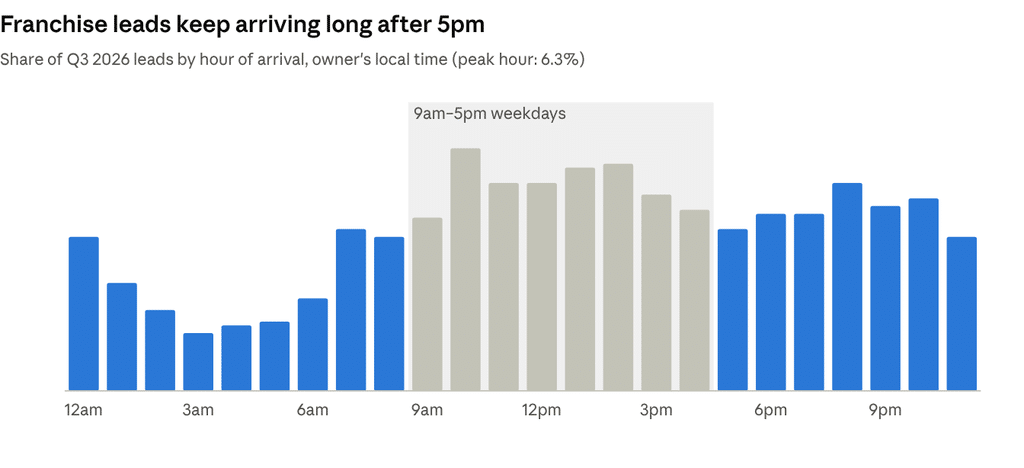
69% of franchise leads arrived outside 9am–5pm on weekdays in Q3 2026. Fewer than a third land while a 9-to-5 team is at a desk. Buyers often research franchises after their own workday ends.
Source: VipeCloud Q3 2026 Franchise Lead Source report, Jul–Sep 2026, all days, arrival time in the lead owner’s local timezone
The share is rising every quarter
Off-hours arrivals were 62% across 2025, then 64.3% in Q1 2026, 67.1% in Q2 and 68.8% in Q3. That’s 6.5 points since 2025. The working day covers less of the market each time it’s measured.
Evenings and weekends carry the volume
- 32.5% of Q3 leads arrived between 5pm and midnight, more than the overnight hours.
- 26.4% arrived on a weekend, up from 25.0% in Q2. Sunday was the second-busiest day of the week.
- Friday is the most 9-to-5 day, and still sent 53.4% of its leads after hours in Q3 (50.5% in Q2). Other weekdays ran 57–60% in Q3. In Q2, Tuesday was the toughest at 62.9%.
- In Q2’s hourly data, the 9am spike was the overnight backlog being seen for the first time, not an arrival peak.
Directory leads are the most nocturnal
| Channel | Leads arriving off-hours (Q3 2026) |
|---|---|
| Franchise Opportunities Network | 80% |
| FranchiseGator | 80% |
| Lead PPC | 73% |
| BizBuySell | 62% |
| Career Transitions FLEX | 37% |
In Q2, Franchise Opportunities Network sent 73% of its leads off-hours. A mix weighted toward directories has a bigger response-time problem than the average suggests.
Why “same-day” response is often next-day
If your response SLA starts at 9am, a lead that arrived at 8pm waits overnight. Measure response time from the lead’s timestamp, not from when your team logs in.
Speed to lead: the first qualification touch
Leads answered by an AI booking agent booked meetings 46% of the time in Q3 2026, against 38% for leads worked by the same team’s own email sequence on the same channel. A quarter earlier the two were level. The first reply is also the first chance to qualify, so the faster it lands, the sooner you learn who’s a real candidate.
| Measure | Q2 2026 | Q3 2026 |
|---|---|---|
| AI agent vs. own sequences, adjusted for business type | +5 points | +5 points (21.5% vs. 16.5%) |
| AI agent vs. own sequence, same team and channel | Level | +8 points (46% vs. 38%) |
| Qualified AI conversations that booked a meeting | — | 1 in 4 |
| Growth in meetings booked end to end by the agent | 10× | +22% |
In Q2 2026, AI agent conversations grew 7.6× on Q1 as teams moved out of pilot. The booking success rate rose 63% (8.7 points) as volume grew almost eightfold. In teams running it, the agent handled three fifths of all leads, and two teams put every lead through it.
Why AI wins after hours
With 69% of leads arriving after the team goes home, the first reply often comes the next morning. An agent answers each lead as it lands, nights and weekends included, and nobody has to build or maintain the sequence.
Stale sequences quietly kill conversion
In Q2 2026, the widest gap wasn’t between channels. It was between teams whose sequences were maintained and teams whose weren’t: booking rates ranged from low single digits to over 40% on identical inventory. Adjusted for business mix, the agent booked roughly a fifth more meetings than a team’s existing sequences, and two to three times as many where those sequences had gone stale.
What this looks like in practice
A candidate finds your brand on a portal at 9:40pm on a Sunday. VipeCloud parses the portal email, creates the contact and starts a text conversation with the AI Booking Agent. The agent answers their questions and offers times for a discovery call. If they go quiet, it follows up. If they ask for a person, it hands the conversation to the owner. By the time your team logs in Monday, the call is on the calendar. That’s what the Franchise Sales Engine is built to do.
How to qualify franchise leads: a six-conversation process
Qualifying a franchise candidate means confirming fit, operating ability and financial readiness in a set order, with a clear decision standard before each next step. Franchise sales usually stalls from unstructured conversations, not a shortage of leads (FranchisorSales.org).
| Conversation | What you’re testing | Advance when |
|---|---|---|
| 1. Initial qualification | Financial capacity and motivation | Capital fits your investment range and the motivation is real |
| 2. Concept fit | The candidate’s goals against your ideal franchisee profile | Goals and the brand’s model align |
| 3. Operations planning | Day-to-day role, leadership, staffing, owner-operator or investor | They can realistically run, or staff, the business |
| 4. Financial and FDD review | Readiness once the full investment and disclosure are understood | Commitment holds after the full numbers |
| 5. Development strategy | Territory, single or multi-unit path, timeline, operating partner | A specific plan is agreed |
| 6. Approval and award | Formal approval and franchise agreement | No surprises left at signing |
Three habits keep it moving according to FranchisorSales.org:
- Give every call a clear objective and a decision standard for advancing.
- Schedule the next meeting before the current call ends.
- Record and review conversations.
The common failures are predictable: unqualified candidates advancing, concept calls turning into one-way presentations, and financial or operational realities surfacing late. You’re awarding a franchise, not selling one. Saying no early protects the brand and the candidate.
In VipeCloud, each conversation can be a stage on a candidate board. Moving a card is the trigger: it can send the next step’s materials, require a reason when a candidate is disqualified, and ask for confirmation before an automation fires. Pipeline views show count, days in stage and win rate for each stage, so you can see where candidates stall.
Nurture the candidates who aren’t ready yet
A candidate who isn’t ready today can still be your next franchisee. When a candidate pauses over timeline, capital or territory, the right next step is a plan to stay in touch, not a closed record.
- Record why they paused, using the same reason list every time.
- Enroll them in a nurture series matched to that reason, such as financing education for capital or market updates for territory.
- Watch engagement. Opens, clicks and site visits show who’s warming up.
- Re-engage on a trigger, such as a territory opening or a check-in at their stated timeline.
VipeCloud’s drip series and contact scoring handle steps 2 and 3. Scores are built from email engagement, web visits and custom events, so the team knows who to call first.
A 5-step franchise recruitment system
A franchise lead generation system that awards more of the right franchisees does five things: defines the profile, funds the sources that convert, answers immediately, qualifies in stages and tracks every source to the award.
- Define your ideal franchisee profile. Fit, funding, ownership model, territory and timeline decide every step after.
- Fund the sources that produce candidates. Rank channels by booked meetings weekly. The two largest channels in Q3 2026 booked 38% and under 5%. Own the capture page too: own-form leads booked about 5× as often as portal leads for brands. Check that AI assistants can read it with the free AEO Scanner.
- Answer every lead the moment it lands, 24/7. 69% arrive after hours. Automated first response reaches them while they’re still looking.
- Qualify in stages, with a standard for each step. Test capital and motivation first, then concept fit, operations, the FDD and the development plan.
- Track every source through to the award. Benchmark against your own segment: consultants book about 1 in 3 leads, and brands under 1 in 10.
How to track franchise lead sources through to the award
Accurate franchise lead tracking starts the moment a lead arrives: parse it, tag its source, and carry that source to the booked meeting, the qualification stages and the signed agreement. Without that, you can count leads but can’t rank channels by the franchisees they produce.
- Parse portal emails automatically. Most franchise leads arrive as portal or directory notification emails. VipeCloud reads them with 30+ prebuilt parsing rules, creating and routing the contact as each lead lands. A parsed lead can trigger automations straight away.
- Tag every lead with one source. Use the channel name, not “Web” or “Other”, so each candidate can be traced to its portal.
- Require a source on every opportunity. When a lead becomes a discovery call, the source moves with it through each qualification stage.
- Record a reason for every disqualification. Reasons by source show which channels send the wrong candidates, not just fewer of them.
- Review the mix weekly. In Q3 2026, eight channels paused and six started within one quarter. Weekly reviews catch a channel going quiet before the quarter is over.
- Benchmark quarterly. Compare your channel mix, timing and booking rates with VipeCloud’s quarterly Franchise Lead Source reports.
Recruit the right franchisees, faster
VipeCloud’s Franchise Sales Engine reads every portal, directory and paid-channel lead as it arrives and answers automatically, including the 69% that arrive when nobody’s at a desk. It then carries each candidate through your qualification stages with the source attached, all the way to the award.
About this data
Figures are aggregated across franchise development organizations using VipeCloud’s prebuilt inbound parsing rules for Q2 2026 (April–June) and Q3 2026 (July–September). They’re reported as shares of total volume. Arrival times use each lead owner’s local timezone, and business hours are 9am–5pm, Monday to Friday. Booking rates are measured across teams that schedule meetings in VipeCloud. No individual organization’s data is identified or disclosed.

Leave a Comment